Views: 0 Author: Site Editor Publish Time: 2026-06-25 Origin: Site
Table of Contents
Why is friction stir welding used for cooling plates?
Liquid cooling plates require internal flow channels sealed hermetically within a flat aluminum plate — typically by welding a machined or extruded channel base to a flat cover sheet. Friction stir welding (FSW) is the preferred joining method because it produces:
Zero-porosity, leak-tight lap joints — helium leak rate <1×10⁻⁷ mbar·L/s, without brazing flux residue
Flatness within ±0.2mm over 500mm spans — critical for thermal contact to battery cells and power modules
No filler metal or flux — eliminates contamination risk inside cooling channels and avoids post-weld cleaning
Joint strength 85–95% of base metal — retains structural integrity under thermal cycling and vibration
The global cold plate market reached USD 421.5 million in 2024 and is growing at 6.3% CAGR through 2034 (GM Insights), driven by EV battery thermal management and data center liquid cooling. FSW-welded cold plates are rapidly displacing vacuum brazed and diffusion-bonded alternatives in high-volume production.
If you manufacture liquid cold plates for EV batteries, power electronics, or data center cooling — FSW is the process your competitors are already evaluating.
The short answer to "FSW vs. brazing for cooling plates":
Criteria | FSW | Brazing |
|---|---|---|
Joint strength | ≥ 90% of parent material | 60–75% of parent material |
Internal channel collapse risk | Minimal (low heat input) | High (350–550°C furnace cycle) |
Leak rate at pressure test | < 1×10⁻⁹ mbar·L/s (hermetic) | Variable, 10⁻⁶ to 10⁻⁸ mbar·L/s |
Heat affected zone width | 3–8 mm | 15–40 mm (full fixture cycle) |
Production cycle time (per part) | 5–15 min depending on size | 30–90 min (furnace + cool-down) |
Fixture complexity | Moderate (weld-specific) | High (full vacuum furnace tooling) |
Aluminum-copper joints | Excellent compatibility | Challenging (galvanic issues) |
Fume / flux residue | None | Flux required, post-clean needed |
If your cooling plate application requires zero leak rates, minimal thermal resistance increase, and production volumes above 500 parts/month, FSW is almost always the better choice. If your parts are very large (>1m²) with simple channel geometry and cost is the primary constraint, brazing warrants a second look.
✓ Zero-porosity joints
✓ Better flatness than brazing
✓ Suitable for complex cooling channels
✓ Supports EV, AI and power electronics
✓ Better scalability for mass production
Cooling plates — also called liquid cold plates, cold plates, or liquid cooling plates — are the backbone of thermal management across three converging megatrends: vehicle electrification, power electronics miniaturization, and AI-driven data center cooling.
Industry | Cooling Plate Application | FSW Adoption | Why FSW Wins |
|---|---|---|---|
EV Battery | Battery pack cooling plates, bottom cooling plates | Dominant | Leak-free + flatness + no flux contamination |
Power Electronics | IGBT/SiC module cold plates, inverter cooling | Growing | Sub-mm flatness, hermetic seal, no flux near semiconductors |
Data Center / AI | GPU/CPU liquid cold plates, rack-level cooling | Emerging | Miniaturized channels, clean internal surfaces required |
Energy Storage | BESS container cooling plates | Growing | Large format, long weld paths, cost-effective at scale |
Medical / Industrial | Laser cooling, medical device cold plates | Niche | Clean process, biocompatible alloy compatibility |
Historically, aluminum cold plates were manufactured by vacuum brazing — stamping or machining channel halves, assembling with brazing foil, and firing in a vacuum furnace. This process works but has persistent issues:
Brazing flux residue inside channels → contamination, flow restriction, long-term corrosion risk
Thermal distortion from furnace cycle → post-brazing flatness often exceeds ±0.5mm, requiring machining
Joint strength limited by braze alloy (typically <60% of base metal UTS)
Energy cost — vacuum brazing furnace runs at 600°C+ with multi-hour cycles per batch
FSW eliminates all four issues simultaneously. This is not incremental improvement — it's a process paradigm shift that major thermal management suppliers have already made.
Modern EV battery packs dissipate 5–20 kW of heat during fast charging and high-performance driving. Liquid cooling plates embedded in the battery floor or sidewall manage this thermal load continuously. A single leak in a cooling plate contaminates hundreds of battery cells — a 20,000–20,000–50,000 scrap event.
Battery cooling plate requirements have hardened significantly:
Leak pressure: 3–5 bar operational, tested to 1.5× working pressure
Flow channel integrity: no deformation that restricts coolant flow
Thermal resistance: < 0.1 K·cm²/W across the plate
IP67 minimum: dust-tight and water immersion protected
Cycle life: 5,000+ thermal cycles without degradation
GPU-dense AI compute clusters (H100, GB200 class) require liquid cooling plates directly mounted to processors. The scale is massive — a hyperscale data center might deploy 50,000–200,000 cooling plates. Quality consistency matters more than any individual part cost.
Wide-bandgap semiconductors (SiC, GaN) operate at junction temperatures of 175–200°C. Cooling plates for traction inverters and on-board chargers require high thermal conductivity aluminum with reliable channel seals under thermal cycling.
Cooling plate manufacturers are no longer evaluating joining technologies based solely on welding quality. Production stability, leak-test consistency, flatness control, manufacturing efficiency, and long-term reliability have become equally important.
Compared with traditional furnace brazing, FSW enables manufacturers to reduce production variation while supporting increasingly complex cooling plate designs and higher production volumes.
As demand for EV batteries, AI data centers, and high-power electronics continues to grow, many manufacturers are transitioning from conventional thermal joining processes toward FSW-based production solutions.
Modern liquid cooling plates are expected to deliver excellent thermal conductivity, leak-tight sealing, dimensional stability, and long-term reliability throughout their service life. However, conventional manufacturing methods—particularly vacuum brazing—often create production and quality challenges that become increasingly difficult to control as production volumes grow.
One of the most common production issues is leak failure after thermal cycling.
Vacuum brazing relies on a filler alloy to bond the cover plate to the channel base. This creates a distinct metallurgical interface between the filler metal and the parent aluminum. During repeated thermal cycling (typically -40°C to +85°C in EV applications), these materials expand and contract at different rates, gradually generating fatigue cracks along the brazed interface.
In high-volume manufacturing, helium leak-test failure rates of 3–8% are not uncommon, while some manufacturers report customer escape rates of 2–5% after 1,000 thermal shock cycles. Every failed cooling plate requires either costly rework or complete replacement, increasing production cost and delivery risk.
By comparison, friction stir welding produces a fully recrystallized solid-state joint without a filler-metal interface. The continuous grain structure significantly improves thermal fatigue resistance and long-term sealing reliability.
Cooling plates must remain extremely flat to maintain uniform thermal contact with battery cells, power modules, or electronic components.
Many battery OEMs specify a post-weld flatness of ≤0.3 mm, yet vacuum brazing exposes the entire assembly to temperatures above 600°C, often resulting in 0.5–1.5 mm of distortion. Additional CNC machining is frequently required to restore flatness, increasing manufacturing cost and extending production time.
High furnace temperatures also soften the cover plate during the brazing cycle, allowing it to deform into the internal flow channels under its own weight and fixture pressure. Even slight channel deformation can reduce hydraulic diameter, increase coolant flow resistance, and lower overall thermal efficiency.
Because FSW applies heat only along the weld path, the surrounding material experiences minimal thermal exposure. This localized heat input helps maintain both channel geometry and overall plate flatness without secondary machining.
Vacuum brazing requires filler materials and fluxes that may leave residues inside sealed cooling channels.
Even after cleaning, residual flux can:
React with glycol-based coolants over time
Form deposits that restrict coolant flow
Increase corrosion risk
Create local hot spots
Conflict with OEM specifications requiring contamination-free internal surfaces
Since friction stir welding is a solid-state process, it requires no filler metal and no brazing flux, producing clean internal channels that are particularly suitable for battery thermal management and precision electronic cooling applications.
As cooling plate designs become increasingly complex, conventional brazing places significant constraints on product design.
Uniform furnace heating makes it difficult to manufacture components with:
Thin cover plates
Variable wall thicknesses
Narrow channel spacing
Complex internal baffles
Asymmetrical flow paths
In addition, joining aluminum and copper remains challenging using conventional fusion welding because excessive heat promotes the formation of brittle Cu-Al intermetallic compounds.
FSW overcomes many of these limitations through localized solid-state joining. With optimized tooling and process parameters, manufacturers can weld more complex channel structures while minimizing intermetallic layer growth in aluminum-copper applications.
As EV, energy storage, and data-center demand continues to grow, manufacturers must increase production capacity without compromising quality.
Vacuum brazing typically requires 4–8 hours for a complete furnace cycle, while expanding production often means investing in additional furnace capacity costing US$500,000–2 million per unit.
In comparison, a typical 300 × 400 mm cooling plate can be friction stir welded in 6–10 minutes, and dual-station FSW systems can achieve production rates of 8–12 parts per hour.
For manufacturers targeting 1,000 or more cooling plates per month, FSW provides a more scalable production model by combining shorter cycle times, higher process consistency, and lower rework rates.
The fundamental cold plate joint is a lap joint: a flat cover sheet welded over a machined or extruded channel base. The FSW tool penetrates through the cover sheet and into the channel base, stirring the two layers together without penetrating into the channel cavity.
Before selecting an FSW process or equipment, manufacturers should evaluate whether the cooling plate design is optimized for solid-state welding. Design decisions made during the early development stage have a direct impact on weld quality, production efficiency, and long-term reliability.
The width of the material between adjacent cooling channels (land width) must provide sufficient support for the FSW tool while maintaining effective coolant flow.
As a general guideline:
Standard FSW tools: Minimum land width of 4 mm
Micro-FSW applications: Land widths down to 2.5 mm with specialized tooling
Insufficient land width may reduce weld stability and increase the risk of channel deformation.
Cover plate thickness directly influences heat input, tool penetration, and welding stability.
Typical recommendations include:
Cover Plate Thickness | Typical Application |
|---|---|
1.0–1.5 mm | Compact electronic cooling plates |
2.0–3.0 mm | EV battery cooling plates |
3.0 mm+ | Large-format industrial cooling systems |
Thinner cover plates require more precise force control to prevent excessive penetration into the cooling channels.
Cooling channel walls must withstand welding forces without collapsing.
During product design, engineers should consider:
Channel wall thickness
Rib support structure
Internal pressure requirements
Coolant flow resistance
A stronger channel structure improves both weld stability and long-term durability.
Different industries specify different sealing standards.
For example:
EV battery cooling systems: Helium leak testing with IP67/IP68 requirements
Power electronics: Long-term pressure cycling resistance
Data center liquid cooling: Continuous coolant circulation with high reliability
Understanding these requirements early helps determine appropriate weld design, inspection methods, and process parameters.
Production volume should also influence cooling plate design.
Manufacturers producing a few hundred parts per year may prioritize flexibility, while high-volume production requires designs that support:
Automated fixture loading
Stable welding paths
Consistent force control
Inline leak testing
Process traceability
Designing for manufacturability (DFM) from the beginning reduces production risk and shortens the transition from prototype validation to mass production.
For cold plate lap welding, axial force control is the single most important variable. The tool must penetrate to a precise depth — typically 0.1–0.3mm into the channel base — without breaking through into the coolant channel below.
Parameter | Typical Range | Why It Matters |
|---|---|---|
Axial force | 5–15 kN (±2% tolerance required) | Controls weld depth; excess force = channel breach |
Tool RPM | 1,000–2,000 RPM | Higher RPM = finer grain structure, better sealing |
Traverse speed | 400–1,200 mm/min | Faster = higher throughput; slower = better consolidation at channel edges |
Tool shoulder diameter | 8–15 mm (compact for narrow lands) | Must fit between channel walls; smaller = less heat input |
Pin penetration depth | Cover sheet thickness + 0.1–0.3mm | The most critical dimension — controls joint integrity without channel breach |
The #1 production risk in FSW cold plate welding is tool penetration through the channel base — creating a leak path directly into the coolant channel. This risk is highest when:
Channel wall thickness varies due to extrusion tolerances (±0.2mm is common)
Tool wear changes penetration depth over the weld cycle
Fixture compliance allows the workpiece to deflect under axial force
Solution: ZHFSW machines use real-time axial force control (±2%) with z-axis height compensation, maintaining consistent penetration depth regardless of these variables. The force control loop runs at 1 kHz — fast enough to compensate for extrusion dimensional variation within a single weld pass.
Alloy | Typical Use | FSW Weldability | Key Advantage |
|---|---|---|---|
6061-T6 | General purpose cold plates | Excellent | Best balance of strength, corrosion resistance, machinability |
6063-T5 | Extruded channel bases | Excellent | Superior extrudability for complex channel profiles |
3003 | Heat exchanger cold plates | Excellent | Highest thermal conductivity, excellent formability |
5052 / 5083 | Marine/corrosive environments | Excellent | Best corrosion resistance for glycol/water coolant systems |
1100 | High-purity thermal applications | Good | Maximum thermal conductivity, lowest strength |
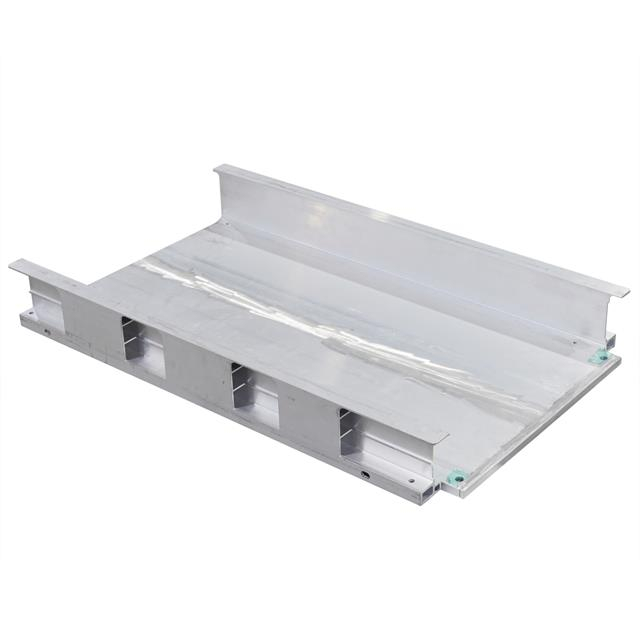
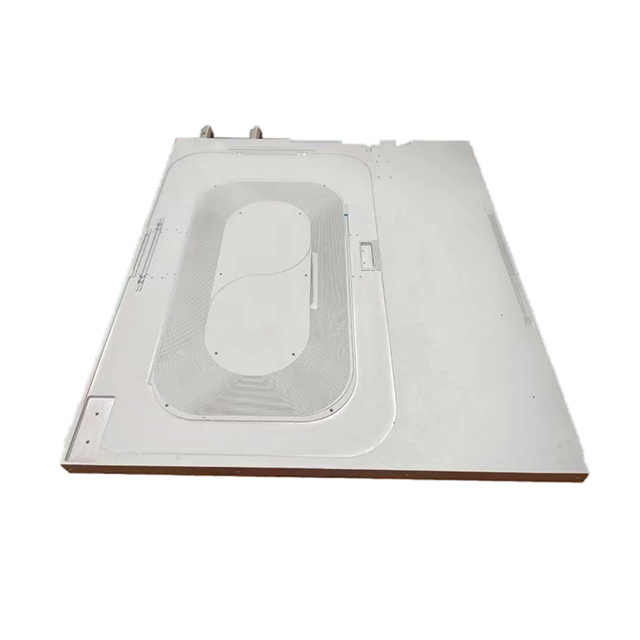
Extrusion-based cooling plates: Machined or extruded channel patterns covered with a flat or contoured cover plate. Common in battery thermal management. Weld is a lap joint over channel features — requires downward force control to avoid channel collapse.
Machined direct cooling (DiCu) plates: CNC-machined from solid aluminum blocks — channels are the machined negative space. Cover plate is a separate piece. Requires full-perimeter butt or lap weld. Higher dimensional precision but thicker walls — more forgiving on force control.
Stamped/bent sheet cooling plates: Formed from stamped aluminum sheets, typically 1–2mm thick. Channels are the gaps between formed features. Very low heat tolerance — FSW is the only viable welding option; arc processes cause severe distortion.
[Cover Plate] ←── Lap weld along channel perimeter ──→ [Base Plate with Channels]
   ↓
Rotating FSW tool (shoulder + pin) traverses along weld path
↓ Plasticized aluminum flows around pin
↓ Consolidates on retreating side = sound metallurgical bond
↓ Minimal heat → channel walls stay rigid → flow path intact
Critical parameter: Z-height (plunge depth) The tool shoulder must apply sufficient downward force to create proper material mixing without over-plunging and collapsing the channel below. ZHFSW servo force control maintains this to ±0.05mm — critical for thin-cover (1–1.5mm) cooling plates.
Retractable pin technology: For hermetic applications, the tool pin retracts into the shoulder before exiting the weld, eliminating the keyhole hole. Without retractable pin tools, the keyhole is a guaranteed leak path on thin lap joints.
When joining Al (6061/3003) to Cu (C11000), the key parameters shift:
Rotational speed: Lower than Al-Al — 600–1200 RPM (vs. 1200–2500 for Al-Al) to reduce heat input
Pin penetration: Must reach into the copper side by 0.3–0.5mm for proper mixing
Tool material: H13 tool steel works; PCBN or tungsten alloys for high-volume production
Weld speed: Slower travel, 200–600 mm/min
Surface preparation: Both surfaces must be clean and oxide-free; a thin Cu flash on the Al side is acceptable
Different cooling plate designs require different welding strategies. Rather than selecting equipment based only on part size, manufacturers should evaluate cooling channel geometry, production volume, leak-tightness requirements, and automation goals.
The table below provides a general guideline for selecting an appropriate FSW solution.
If Your Requirement Is... | Recommended FSW Solution |
|---|---|
Thin cover plates (1.0–1.5 mm) | High-precision servo force control with vacuum fixtures |
Narrow channel spacing (<4 mm) | Micro-FSW tooling with compact shoulder design |
Large-format battery cooling plates | Large gantry FSW systems with high-rigidity structures |
Aluminum-to-copper cooling plates | Dedicated Al-Cu welding tools and optimized process parameters |
High-volume production (>1,000 parts/month) | Dual-station FSW systems with automated loading and unloading |
Extremely low leak-rate requirements | Retractable pin technology with inline helium leak testing |
Multiple cooling plate models | Flexible fixtures with programmable welding recipes |
Full OEM quality traceability | FSW systems integrated with MES and process data recording |
Not all channel geometries are equally FSW-friendly. Key design rules:
Land width (solid area between channels): minimum 4mm for standard FSW tools; 2.5mm possible with micro-FSW tools
Channel wall thickness: minimum 1.0mm below the weld zone; 1.5mm recommended for production safety margin
Cover sheet thickness: 1.0–3.0mm typical; thinner = tighter force control requirement
Cold plate fixtures require flat clamping with zero part distortion:
Vacuum fixture: best for thin cover sheets (1–2mm), applies uniform clamping without point loads
Mechanical clamp fixture: better for thicker plates (3mm+), higher rigidity, faster load/unload
Hybrid: vacuum hold + edge toggle clamps for combined hold-down and positional accuracy
Weld sequence affects distortion and residual stress:
Weld from center outward to minimize bow
Alternating sides on multi-pass plates to balance thermal input
Parallel paths rather than serpentine to avoid cross-contamination of weld starts/stops over channels
Inline quality for cold plates:
Helium leak test: inline, 30-second test at 0.3 bar — the gold standard
Flatness scan: laser or contact probe post-weld — 100% inspection for battery cooling plates
Weld depth verification: cross-section macros on first article and periodic sampling (1 per 50–100 parts)
Before committing to production, validate these parameters:
Test | Method | Pass Criteria |
|---|---|---|
Leak test | Helium mass spectrometer or pressure decay | < 1×10⁻⁸ mbar·L/s or ≤ 0.5 mbar/min decay |
Tensile shear | Cross-section weld sample, ISO 4136 | ≥ 85% of weaker parent material |
Microstructure | Weld cross-section, etched | No porosity, no lack of fusion, fine equiaxed grains |
Channel dimension | CMM or profilometer before/after | Flow restriction increase < 5% |
Thermal cycling | -40°C to +85°C, 1000 cycles | Zero leaks post-cycling |
Pressure burst | Hydrostatic to 2× working pressure | No rupture or permanent deformation |
A typical friction stir welding process for aluminum cooling plates includes the following production stages:
Step | Process | Key Activities |
|---|---|---|
1 | Cooling Plate Design Review | Verify channel layout, land width, cover thickness, and weld path. |
2 | Material Preparation | Inspect aluminum material, clean surfaces, and confirm dimensional accuracy. |
3 | Fixture Setup | Install vacuum or mechanical fixtures to ensure full contact between the cover plate and channel base. |
4 | FSW Welding | Execute the welding program with controlled axial force, spindle speed, and travel speed. |
5 | In-Process Inspection | Monitor weld parameters, verify weld consistency, and record process data. |
6 | Leak Testing | Perform helium leak testing or pressure testing to verify sealing performance. |
7 | Post-Processing | Deburr, clean, and perform optional surface finishing if required. |
8 | Final Inspection | Check flatness, dimensions, traceability records, and prepare for shipment. |
Although individual manufacturing processes vary by product design, most production lines follow a similar workflow from design validation to final quality inspection. Early process planning helps improve production stability and reduce qualification risks.
Different cooling plate applications require different machine configurations depending on part size, channel complexity, production volume, and quality requirements. Rather than selecting equipment based solely on dimensions, manufacturers should evaluate welding stability, force control capability, fixture integration, and automation requirements.
Model | Max Plate Size | Spindle Force | Best Application |
|---|---|---|---|
FSW-A10 / A10S | Compact / 600×600mm | 20 kN | IGBT cold plates, power module cooling, data center cold plates |
FSW-BL2520 | 2500×2000mm | 30 kN | EV battery bottom cooling plates, BESS cooling plates |
FSW-BL3020 | 3000×2000mm | 40 kN | Large-format EV battery cooling plates, multi-module packs |
Maintaining stable axial force is one of the most critical requirements in cooling plate FSW.
Even slight variations in force may affect:
Weld penetration consistency
Channel integrity
Leak-tight performance
Thermal contact quality
For production-grade cooling plate welding, modern FSW systems typically employ closed-loop servo force control capable of automatically compensating for extrusion tolerances, fixture variation, and gradual tool wear.
Zhihui Welding integrates ±2% force-control accuracy across its cooling plate FSW platforms to support consistent production quality.
Cooling plates used in EV batteries, power electronics, and AI servers often feature narrow channel spacing that standard FSW tools cannot accommodate.
Production systems designed for these applications should support compact shoulder geometries and application-specific tool profiles to ensure sufficient material flow while preventing channel deformation.
Zhihui Welding supports micro-FSW tooling with shoulder diameters as small as 8 mm for compact cooling plate applications.
Fixture design is as important as the welding process itself.
A properly engineered fixture should:
Maintain full contact between the cover plate and channel base
Prevent local deformation during welding
Improve weld consistency
Reduce setup variation between production batches
For thin cooling plates, vacuum-assisted fixtures are widely used because they provide uniform clamping without introducing excessive localized stress.
Zhihui Welding develops application-specific fixture solutions together with each cooling plate welding project.
Many cooling plate manufacturers are integrating leak testing directly into the welding cell to reduce downstream inspection costs and improve production efficiency.
Typical inline inspection includes:
Helium leak testing
Flatness inspection
Weld parameter recording
Part traceability
Zhihui Welding offers optional inline leak-test integration for customers requiring automated quality verification.
Common cooling plate configurations include:
6061 cover + 6063 extruded channel base
6061 cover + 3003 machined base
6061 cover + 6061 machined base
Actual welding parameters should always be validated according to channel geometry, wall thickness, production volume, and quality requirements before mass production.
Zhihui Welding develops optimized process parameters during project validation.
Results vary depending on cooling plate geometry, material combination, fixture design, and production parameters.
✅ Helium leak test pass rate: >99.5% at production volume
✅ Post-weld flatness: <0.25mm over 1,500mm plate length (no post-weld machining required)
✅ Channel breach rate: <0.02% — controlled by axial force compensation
✅ Weld cycle time: 8–12 minutes per plate on a typical 400mm × 300mm IGBT cold plate
✅ Tool life: 1,500+ meters on 6061/6063 cold plate welds
Cooling plate welding often requires tooling specifically designed for channel geometry, cover thickness, and material combination.
Typical tooling options include:
Extended-shoulder tools
Retractable pin tools
Al-Cu dedicated tool profiles
High-wear-resistant tooling for continuous production
ZHFSW customizes tooling solutions according to individual cooling plate designs and production requirements.
Evaluation Criteria | Friction Stir Welding (FSW) | Vacuum Brazing | Recommended Choice |
|---|---|---|---|
Leak Tightness | Excellent (<1×10⁻⁷ mbar·L/s) | Good, depends on filler quality | FSW |
Joint Strength | 85–95% of base material | 60–75% of base material | FSW |
Flatness Control | Excellent (localized heating) | Additional machining often required | FSW |
Thermal Distortion | Very Low | High due to furnace heating | FSW |
Production Cycle | 5–15 min/part | 4–8 hour furnace cycle | FSW |
Internal Cleanliness | No flux or filler residue | Flux cleaning required | FSW |
Design Flexibility | Excellent for complex channels | Limited by furnace process | FSW |
Aluminum–Copper Joining | Suitable with optimized parameters | Difficult | FSW |
Scalability | Easy to expand with additional machines | Requires additional furnace capacity | FSW |
Initial Equipment Cost | Moderate | High (vacuum furnace) | Depends on Production Volume |
Best Application | High-volume, precision cooling plates | Large simple parts or low-volume production | Depends on Application |
Selection Tip: If your cooling plate project requires high leak-tightness, minimal distortion, complex channel designs, or large-scale production, FSW is generally the preferred manufacturing process. Vacuum brazing remains suitable for certain low-volume or large-format applications where design complexity and sealing performance are less demanding.
As cooling plate designs become more complex and production volumes continue increasing, manufacturers require joining technologies that deliver not only leak-tight welds, but also consistent quality, dimensional stability, and scalable production efficiency.
Friction stir welding has become one of the most reliable manufacturing solutions for aluminum cooling plates because it combines low heat input, high structural integrity, and excellent process repeatability.
For manufacturers planning next-generation thermal management products, selecting the appropriate welding process early in product development can significantly reduce qualification risk while improving long-term production performance.
It depends on your production requirements. For most EV battery, power electronics, and liquid cooling plate applications, friction stir welding offers lower distortion, higher joint strength, and more consistent leak performance than vacuum brazing. FSW also eliminates brazing filler metals and flux residues, reducing contamination risks inside coolant channels. However, very large or low-volume components may still be suitable for brazing.
Yes. Properly developed FSW processes can routinely achieve helium leak rates below 1×10⁻⁷ mbar·L/s, making them suitable for EV battery cooling systems, power electronics, and other applications requiring hermetic sealing. Final performance depends on material quality, joint design, tooling, and process control.
Yes. FSW is particularly suitable for cooling plates with machined or extruded flow channels because it applies localized heat rather than heating the entire assembly. Proper force control and fixture design help maintain channel dimensions and prevent deformation during welding.
The most common alloys include 6061, 6063, 3003, 5052, and 5083, depending on thermal conductivity, corrosion resistance, and structural requirements. Material selection should also consider channel geometry, coolant type, and long-term thermal cycling performance.
Unlike furnace brazing or conventional fusion welding, FSW is a solid-state process with significantly lower heat input. This minimizes thermal expansion and residual stress, allowing manufacturers to maintain tighter flatness tolerances while reducing post-weld machining.
Before choosing equipment, manufacturers should evaluate:
Cooling plate dimensions
Channel layout and land width
Material and cover plate thickness
Leak-test requirements
Production volume
Required automation level
Quality traceability requirements
These factors determine machine configuration, tooling, fixtures, and process parameters.
Yes. Most production systems can support multiple cooling plate models by changing fixtures, welding programs, and tooling. The level of flexibility depends on differences in part size, channel geometry, and production requirements.
Production validation typically includes helium leak testing, dimensional inspection, flatness measurement, weld cross-section analysis, pressure testing, and thermal cycling verification. Many manufacturers also monitor welding parameters such as spindle speed, axial force, and travel speed to ensure consistent production quality.
This is one of the most challenging thermal management applications. With optimized tooling and process parameters, FSW can join aluminum and copper while limiting brittle intermetallic compound formation, making it suitable for selected power electronics and high-performance cooling applications.
The decision depends on several factors, including production volume, leak-tightness requirements, flatness tolerance, channel complexity, material combination, and manufacturing cost. FSW is generally preferred for high-volume production requiring excellent sealing performance and dimensional stability, while brazing may remain suitable for certain low-volume or very large-format applications.