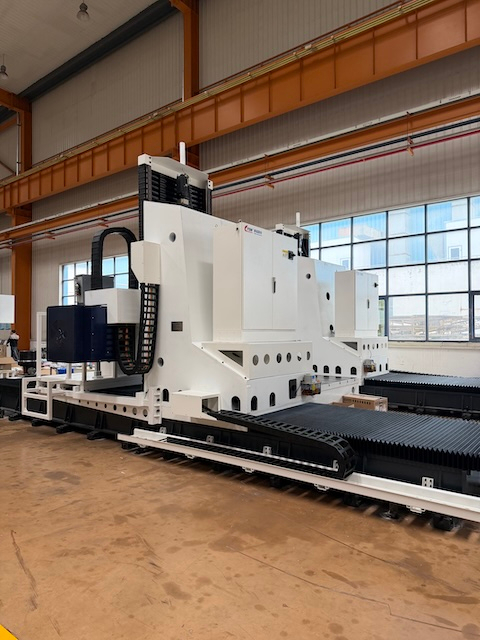
Zhihui provides vacuum chamber FSW equipment for manufacturers producing aluminum vacuum chambers with long weld seams, precision structural requirements, and application-specific welding layouts.
Unlike standard friction stir welding machines selected mainly by nominal working size, vacuum chamber FSW equipment must be evaluated together with the actual chamber geometry, weld position, fixture structure, backing support, tool accessibility, dimensional requirements, and production method.
Depending on the application, the solution may use a standard or modified FSW platform, or a fully customized large-format, multi-axis, or multiple-spindle machine architecture.
Our objective is not simply to supply a machine with sufficient travel. We develop the machine structure, fixture, FSW tooling, and process around the actual vacuum chamber and its production requirements.
FSW equipment can be evaluated for aluminum vacuum chamber structures including:
Rectangular aluminum vacuum chambers
Large welded chamber bodies
Precision aluminum vacuum enclosures
Long linear chamber assemblies
Chamber cover structures
Machined aluminum chamber sections
Chambers with long or opposing weld seams
Custom industrial and scientific vacuum structures
The final equipment configuration depends on the chamber dimensions, aluminum alloy, material thickness, joint design, weld path, fixture conditions, dimensional requirements, and production volume.
Friction stir welding is a solid-state joining process. Because the aluminum is joined without forming a conventional molten weld pool, the process can help reduce thermal distortion compared with many fusion-welding methods.
This can be particularly valuable for large chamber structures containing machined interfaces, flanges, or dimensional features that must be controlled after welding.
CNC-controlled FSW equipment can produce long continuous weld paths when sufficient machine travel, backing support, clamping, and tool access are provided.
Because there is no conventional weld-pool solidification, FSW avoids problems such as solidification cracking and weld-pool porosity associated with fusion welding.
However, FSW still requires correct penetration, process parameters, joint fit-up, and fixture control. Final chamber performance must be validated according to the customer's acceptance requirements.
Spindle speed, travel speed, tool position, welding sequence, and other process variables can be controlled through the equipment system, supporting repeat production after the process has been validated.
Large vacuum chambers do not always fit a conventional gantry machine layout. Depending on weld position and component geometry, customized horizontal, mirrored, multi-axis, or multiple-spindle configurations can be evaluated.
Not every vacuum chamber requires a fully customized FSW machine.
A standard or modified machine platform may be suitable when the chamber dimensions, weld path, fixture space, and tool accessibility fall within an existing equipment envelope.
A customized FSW system becomes more appropriate when the application requires:
Very long weld seams
Large or unusual chamber dimensions
Opposing welding positions
Multiple welding directions
Special tool-access requirements
Additional rotary or angular axes
Multiple spindle systems
Large dedicated fixtures
Special loading or automation requirements
For this reason, equipment selection should begin with the vacuum chamber drawing and production process, not only with a machine model or nominal table size.
X, Y, and Z travel can be selected or customized according to chamber dimensions, weld length, fixture size, and required tool access.
Angular and rotary axes can be incorporated when the chamber geometry requires additional tool orientation or access.
A conventional single-spindle system may be suitable for many applications. For special chamber geometries or opposing weld arrangements, multiple-spindle configurations can also be evaluated.
Depending on the workpiece, possible equipment architectures can include standard machine platforms, large-format systems, horizontal arrangements, mirrored configurations, or other dedicated structures.
The fixture must resist welding loads while maintaining joint fit-up and supporting the chamber along the weld path.
Fixture development may therefore include backing support, clamping layout, workpiece positioning, loading access, and dimensional-control considerations.
FSW tool geometry and material are selected according to the aluminum alloy, material thickness, joint design, penetration requirement, and production conditions.
Explore our friction stir welding tools for customized welding applications.
Zhihui has developed customized FSW equipment for a real large aluminum vacuum chamber application.
The project uses an open horizontal mirrored machine architecture with dual spindle systems and 6000 mm X-axis travel on both sides, allowing the equipment layout to match the chamber geometry and long welding paths.
This project demonstrates an important principle of vacuum chamber equipment selection:
the machine architecture should follow the workpiece and weld layout rather than forcing every component into one standard machine design.
The complete machine specifications, actual chamber photographs, and project configuration are presented on our friction stir welding machine for aluminum vacuum chambers product page.
Before equipment selection, the following information should be reviewed:
Project Requirement | Information Needed |
|---|---|
Chamber size | Overall length, width, and height |
Material | Aluminum alloy and temper |
Thickness | Thickness at each FSW joint |
Joint configuration | Butt, lap, cover, or other design |
Weld path | Location, length, direction, and number of seams |
Tool access | Available access around walls, flanges, and features |
Fixture conditions | Backing and clamping requirements |
Dimensional control | Flatness, position, or machining tolerances |
Vacuum requirement | Customer-defined vacuum or leak-test criteria |
Production volume | Prototype, batch, or repeat production |
Automation | Loading, positioning, or production-line requirements |
These factors determine the required working envelope, machine structure, spindle capability, axis configuration, fixture concept, and process-development approach.
Zhihui combines equipment development with practical FSW application experience.
A typical vacuum chamber equipment project can progress through:
Workpiece evaluation → equipment configuration → fixture design → FSW tooling → process development → welding validation → production implementation
This allows the machine, fixture, tooling, and process to be developed as one manufacturing system.
For other equipment applications, explore our friction stir welding machines for EV and industrial aluminum applications.
Working envelope, machine architecture, spindle arrangement, axis capability, and fixture requirements are evaluated from the actual component rather than one fixed machine specification.
Our equipment capability is supported by actual aluminum vacuum chamber projects rather than application concepts alone.
Equipment performance depends on more than machine travel and spindle speed. We consider the machine, fixture, FSW tooling, joint configuration, and welding process together.
Where a conventional FSW platform cannot provide suitable welding access or working space, dedicated large-format, multi-axis, mirrored, or multiple-spindle configurations can be evaluated.
Our objective is to help manufacturers establish a practical and repeatable vacuum chamber FSW production capability, from initial drawing evaluation through equipment implementation.
Explore more friction stir welding applications for EV, thermal management, and industrial aluminum manufacturing.
For large EV battery trays and oversized aluminum structures:
Explore Large Gantry FSW Machines
For compact and precision aluminum components:
Explore FSW-A10 Series Machines
View the complete equipment range:
Explore Friction Stir Welding Machines
Q1: What type of FSW equipment is suitable for aluminum vacuum chambers?
The appropriate equipment depends on chamber dimensions, material thickness, weld path, joint design, fixture conditions, and tool accessibility. Some applications can use an existing machine platform, while large or complex chambers may require customized equipment.
Q2: Does every vacuum chamber require a customized FSW machine?
No. If the workpiece dimensions, weld positions, fixture, and tool access fit an existing machine platform, a standard or modified machine may be sufficient. Customized equipment is mainly required when the component geometry or production process exceeds standard machine capabilities.
Q3: Can FSW equipment be customized for very long vacuum chambers?
Yes. Extended machine travel and dedicated machine structures can be evaluated according to the actual chamber length and weld path. Zhihui has real vacuum chamber project experience using dual 6000 mm X-axis travel.
Q4: Can the system weld different sides of a chamber?
Depending on the component geometry, rotary axes, angular axes, mirrored machine structures, multiple spindle systems, or other customized configurations can be evaluated.
Q5: Do you provide fixtures together with the FSW equipment?
Yes. Fixture and backing requirements can be developed according to the chamber geometry, weld path, welding loads, and production requirements.
Q6: Can you provide FSW tooling with the machine?
Yes. FSW tools can be developed according to the aluminum alloy, material thickness, joint configuration, and welding conditions.
Q7: Does FSW guarantee a leak-free vacuum chamber?
No welding process alone guarantees final vacuum performance. Leak-tightness also depends on chamber design, joint preparation, process control, machining, sealing interfaces, and final inspection. The welding process should be validated against the customer's specified criteria.
Q8: What information should we provide for equipment evaluation?
Please provide the chamber drawing, overall dimensions, aluminum alloy and temper, material thickness, weld locations, dimensional requirements, vacuum or leak-test criteria, and expected production volume.
Looking for the right FSW equipment configuration for an aluminum vacuum chamber?
Send us your chamber drawing, material specifications, weld locations, dimensional requirements, and production plan. Our engineering team will evaluate whether an existing FSW platform or a customized machine configuration is the more suitable solution for your project.